What else? For computer users of today screens with a bright background looking like a piece of paper is something very natural. Or has anybody ever tried to read the print on used carbon paper? At the beginning, manufacturer were happy with monitors displaying green characters on dirty gray background. When we first discussed the issue of positive polarity, all computer manufacturers of the world unanimously stated that this was unnecessary because readability did not differ in either polarity. And introducing bright backgrounds would cause very high costs that would lead to a decline of computer technology! They have continued submitting expert reports, conference papers et al. until the middle of the 1990s claiming that negative polarity had many virtues. Interestingly, in the middle of 1980s a number of research reports from IBM ergonomic laboratories had been published validating what had been written a decade ago.
The importance of the positive polarity for computer monitors was demonstrated by Dr. Çakir in the year 1976 with the following rationale:
- A bright background improves the performance of the human eye.
- Reflections on the screen, almost unavoidable in normal environments cause less impairments for vision and well-being if the background is bright.
- People like to work in bright environments. Work equipment should not be much darker than the environment.
- Monitors should offer the optical quality of good print.
Unfortunately, during those times, monitors of the required quality did exist in theory or in laboratories. The monitor technology became somewhat mature in 1983, still flickering. The first computers employing monitors with bright background emerged in 1981 (Xerox Star) and 1984 (Apple Macintosh), with more or less flickering images, though. The major breakthrough came with Windows 3.1 in the year 1991. Monitors with a crisp sharp and flicker free image have become everyday products in the 21st century. For the emergence of computer monitor resembling the optical quality of good print for everyone, we need to wait some more years. For the happy few, 4K-monitors seem to offer a visual quality like print, but on a much bigger area.
This important achievement people owe German health and safety organizations (Berufsgenossenschaften) who have introduced safety rules in 1980 requiring positive polarity for all workers, well knowing that during this year not a single product would pass the test. The secret of the success was the introduction of a lengthy transition period of five years and tolerating some deviations from the rules under the condition that the product offers some benefits for the users.
back to: Goals achieved

The first office workplaces with VDTs installed during the 1970s have been designed following the ideas after which the workstations of military flight controllers had been designed a further decade ago. The users of these workstations have been healthy young man with controlled eyesight. And for safety reasons, they were not allowed to work longer periods of time. Thus, they did not feel a problem working at visual distances of about 330 mm – a legacy of the ophthalmologists of the 1920s who had fixed this reading distance. That this distance was not adequate, even for cutting onions in a kitchen, did not matter.
People working in offices perform different tasks than military flight controllers, their average age is much higher, and more than half of them is „visually handicapped“ – they need glasses. With a standard visual distance of 330 mm, at least half of the office workers beyond the age of 40 would need reading glasses even if they can live without in their usual environment. In addition, research from the late 1960s had revealed that the usual correction of the eyes of people wearing glasses was not adequate for at least 30% of the population. Would such people be able to work „9 to 5“ with a computer monitor?
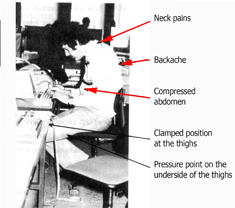 This photo, still being cloned in various publications of all kind, has convinced even the militant ophthalmologists. It was possible to standardize the visual distance for future workplaces to 500 mm. Many physiologists would suggest a much longer distance. The newest ISO-standard on workplace design has successfully changed it to 600 mm. People shall be able to change their distance to the monitor by ± 150 mm. Thus, a comfortable range of 450 mm to 750 mm has been standardized. A dream for many millions of users who suffer from near visual work – even in one of the biggest countries of the world: Desks in the USA mostly do not support such distances. It is interesting to watch how they cope with this health hazard.
By the way, the photo made it to one of the most remarkable graphics on the development of the human being:
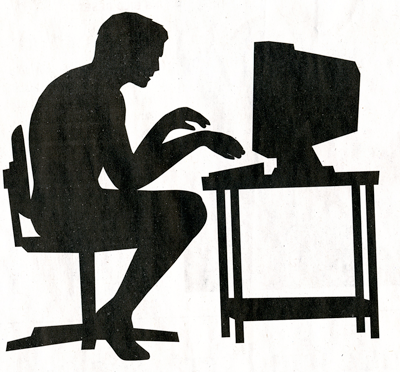

In a remarkable phase of history when the world and the working world experienced the presumably widest transition of their history by the introduction of powerful technologies, including computers and communication technology, the development of office furniture displayed almost a standstill. The relevant DIN-standard for office furniture from the year 1936 was replaced in 1968 without changing much of the overall design of the furniture. All desks continued having a desktop with four edges and four legs with a more or less restricted space for the legs of the users. And the technology of the ban-saw ruled the design of office furniture!
Those performing work with office machines (typewrites, calculators) were granted the smallest and the lowest furniture with no sufficient space to place their legs. And, of course, it was almost impossible to move them. In the advent of the introduction of computers, people felt comfortable with the idea of using such desks for computer users, too. Why new design ideas – are computers no office machines?
Some organizations felt a need for experimenting with new designs because the industry failed to offer new product ideas. We have tried to find the optimum solution for a computerized workplace as a standard. Despite the fact that we have searched through 30 big organizations with many of them implementing their own solutions, no „standard“ was detected.
The „standard“ was established although the „standard solution“ was not found, but the insight that this would possibly never happen. Thus, the solution was preventing that the manufacturer of the furniture and the manufacturer of the machine determine the optimum way of using the technology. To achieve this goal, the computer manufacturers needed to separate their keyboard from the display units, and provide products with low profile, not higher than 30 mm in order to enable users or employers to organize the workplaces according to their needs and to enable them to reorganize them without causing costs and effort. And the furniture should enable people to organize different workplaces using the same equipment.
The promoters of this achievement have been DIN by issuing standards with a prospective nature, and the German Berufsgenossenschaften by establishing safety rules that have encouraged change.
back to: Goals achieved
The legal requirements concerning the protection of workers´ eyes (Directive 90/270/EEC) as given below date back to 1970s when Dr. Cakir and colleagues have performed a fundamental work on the use of computer and the impact on health and safety (s. Cakir, A.; Reuter, H.-J.; Schmude, L.v.; u.a.: Anpassung von Bildschirmarbeitsplätzen an die physische und psychische Funktionsweise des Menschen, BM für Arbeit und Sozialordnung, Bonn, 1978).
„Article 9
Protection of workers’ eyes and eyesight
1. Workers shall be entitled to an appropriate eye and eyesight test carried out by a person with the necessary capabilities:
– before commencing display screen work,
– at regular intervals thereafter, and
– if they experience visual difficulties which may be due to display screen work.
2. Workers shall be entitled to an ophthalmological examination if the results of the test referred to in paragraph 1 show that this is necessary.
3. If the results of the test referred to in paragraph 1 or of the examination referred to in paragraph 2 show that it is necessary and if normal corrective appliances cannot be used, workers must be provided with special corrective appliances appropriate for the work concerned.
4. Measures taken pursuant to this Article may in no circumstances involve workes in additional financial cost.
5. Protection of workers’ eyes and eyesight may be provided as part of a national health system.“
The first implementation of the idea was a collective agreement between the German unions of printers and journalists and the respective employer associations signed after a long industrial action. One of the most interesting aspects of this industrial action may be seen in its focus: Quality of work and work environment.
The international breakthrough of the idea has commenced with the publication of the book “The VDT Manual” (s. Cakir, Hart, Stewart, 1979) containing a document entitled „Eye tests for VDU operators“ (VET), and installing a VET Advisory Group.
First large scale implementation of comparable tests took place in Germany with the regulation of the so called „Principle G37“ as a measure of overall medical prevention for all office workers. The later issued legal requirements of the EU focus on eyesight only.
Currently, the prevention for the eyesight is part of the ArbMedVV (Ordinance on Occupational Health Care, latest version from Oct. 2013)
back to: Goals achieved
Usability related courses are being offered in a variety of countries. The following (and much more) links can be found in UsabilityNet, a project funded by the European Union to promote usability and user centred design. To get information on all activities of UsabilityNet, please follow the link on the right.
Australia … more: Austria … more: Belgium … more: Canada … more: Finland … more: France … more: Germany … more: Ireland … more: Israel … more: Italy … more: The Netherlands … more: Poland … more: Spain … more: Sweden … more: Switzerland … more: United Kingdom … more: United States … more
Cakir, A.; Ordonez de Pablos, P.: Social Development and High Technology Industries – Strategies and Applications
(more…)
Cakir, G.: Qualitätszeichen für techische Produkte im Büro – Informationshilfe für die Beschaffung
(more…)
Cakir, A.; Cakir, G.: Einfluss von optischen Oberflächeneigenschaften von IT-Produkten auf Benutzer (more…)
Cakir, A.; Cakir, G.: Bedeutung von Querschnittsnormen – dargestellt am Beispiel Maschinensicherheit (more…)
Cakir, A.; Cakir, G.: Influence of optical surface properties of IT products on users (more…)
Luczak, H.; Cakir, A.; Cakir, G. (Hrsg.): Work With Display Units 2002 (more…)
Cakir, A.; Cakir, G.: Beleuchtung von Bildschirmarbeitsplätzen- Neue Regelungen, neue Konzepte, neue Lösungen (more…)
Luczak, H.; Cakir, A.; Cakir, G. (Hrsg.): Work With Display Units 92 – Abstractbook (more…)